

A D2C founder in Bangalore booked a full day shoot, paid the invoice, and showed up with nothing but a product box and a vague “make it look premium.” Six hours later she had eighty beautiful photos and not one she could actually use. No lifestyle shots for Instagram, no clean cutouts for Amazon, no group shot for the website banner. The photographer had delivered exactly what was asked for. The problem was nobody had actually asked for anything.
That is what happens when a business skips learning how to brief a photographer before the shoot day, not during it.
Table of Contents
- Why Most Brand Shoots Go Wrong Before the Camera Comes Out
- What Happens When You Do Not Know How to Brief a Photographer
- What Should Go Into a Brand Shoot Brief
- A Simple Photography Brief Template You Can Actually Use
- Questions to Answer Before You Send the Brief
- How Perspectives Works With Your Brief
- Conclusion
- FAQs
- Key Takeaways
Why Most Brand Shoots Go Wrong Before the Camera Comes Out
Here is the part most business owners get backwards. They assume a good photographer will figure out what the brand needs on the day. A skilled photographer can absolutely read a room, adjust lighting, and improvise a composition. What they cannot do is read your mind about which platform the photos are for, what your brand guidelines actually say, or which three shots are non-negotiable for the website launch next week.
That gap is exactly why knowing how to brief a photographer matters more than picking the “best” photographer in Bangalore. A mid-tier photographer with a sharp brief will consistently outperform a brilliant photographer working off a one-line WhatsApp message. Even PetaPixel’s own guide to briefing a photographer makes the same point: the client’s aims decide the outcome long before the camera comes out.
What Happens When You Do Not Know How to Brief a Photographer
Skip the brief and the cost shows up later, usually when it is expensive to fix.
- You pay for a reshoot. A missing brief means missing shots, and missing shots often mean booking the studio, the model, and the photographer all over again.
- The visuals do not match your brand. Without direction, a photographer defaults to their own style, which might be beautiful and still completely wrong for a brand with a specific colour palette, mood, or tone.
- Nobody owns the outcome. If there is no brief, there is nothing to check delivery against, so disagreements about “this is not what we wanted” become impossible to resolve fairly.
- The team wastes shoot-day hours deciding on the spot. Every minute spent debating angles or props on set is a minute not spent actually shooting, and studio time is rarely cheap.
None of this is about the photographer being bad at their job. It is almost always a business that never learned how to brief a photographer properly, and assumed good intentions would fill the gap.
What Should Go Into a Brand Shoot Brief
Once you know how to brief a photographer in principle, the next question is what actually goes on the page. A strong brand shoot brief is not a mood board and a hope. It is a working document the photographer, the stylist, and your own marketing team can all read the same way. As VSCO’s guide to creative photography briefs puts it, a good brief bridges the gap between a client’s vision and the photographer’s execution, which is exactly the gap most rushed shoots fall into.
At a minimum, every brief needs to cover:
- The objective. Is this shoot for a website relaunch, a product launch, a leadership refresh, or social content? One clear goal beats five vague ones.
- The shot list. Exact deliverables, not general themes. “Ten flat-lay product shots and four lifestyle shots with a model” is usable. “Some nice product photos” is not.
- Brand guidelines. Colour palette, existing visual references, fonts if relevant, and anything the brand should never look like.
- Platform and format. Website hero images need different crops and resolutions than an Instagram carousel or an Amazon listing.
- Location and props. Studio or on-site, natural light or controlled, any specific props or backdrops that need arranging in advance.
- Timeline and usage rights. When the final images are needed, and where they will be used, since usage rights change the scope of a project.
This is the backbone of how to brief a photographer well, and it works whether you are booking a single half-day shoot or a full brand campaign.
A Simple Photography Brief Template You Can Actually Use
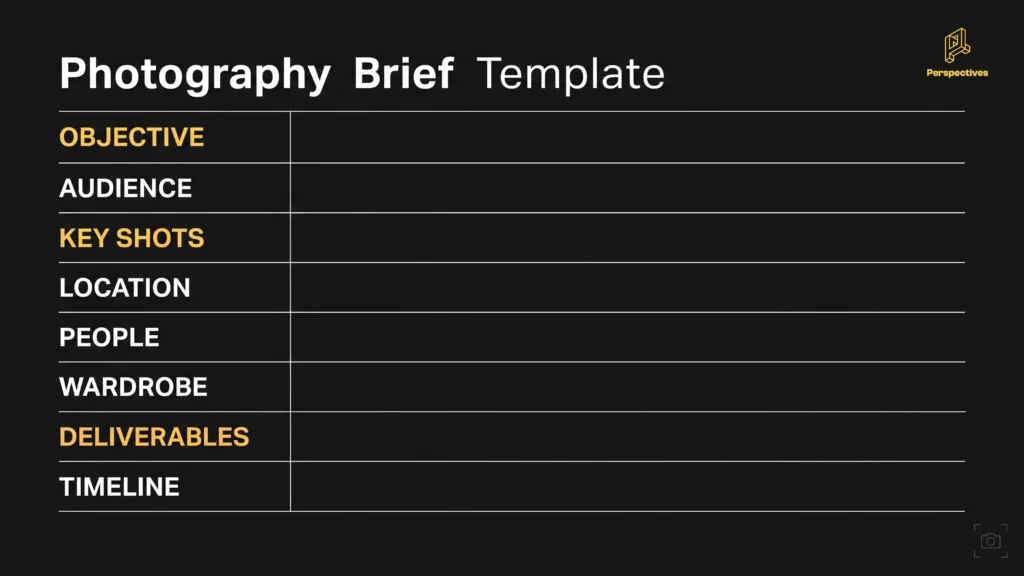
Most businesses do not need a fifteen-page creative document. A short, specific photography brief template gets a photographer further than a long one nobody reads properly.
Here is a simple template that covers the essentials without becoming a chore to fill out:
| Section | What to Include |
| Project name and date | Shoot name, date, location, point of contact |
| Objective | One sentence on why this shoot exists |
| Shot list | Numbered list of exact deliverables |
| Brand references | Links or images showing the look you want |
| Platforms | Where each image set will be used |
| Must-haves | Non-negotiable shots or angles |
| Avoid list | Styles, colours, or compositions to avoid |
| Timeline | Shoot date and final delivery date |
Filling this template out before the call with your photographer saves everyone from a shoot day full of guesswork. Send it a few days ahead so questions can be resolved before the studio clock starts running.
Questions to Answer Before You Send the Brief
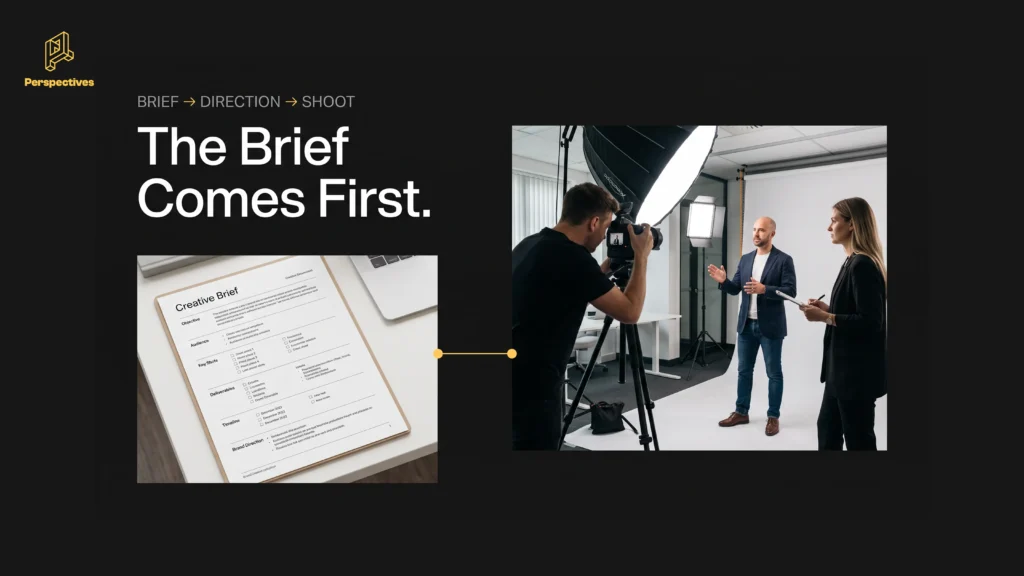
A brief is only as good as the thinking behind it. Before you send yours, sit with these questions.
Who is actually going to see these photos, and where? A brief written for a LinkedIn audience looks nothing like one written for an Amazon listing. What does “premium” or “clean” actually mean for your brand, in specific visual terms rather than adjectives? And what has gone wrong on a past shoot that you do not want repeated this time?
Answering these before you sit down to write the brief is what separates a business that knows how to brief a photographer from one that is still guessing. If you are planning a full company website refresh rather than a single campaign, our guide on how to plan a brand photoshoot for your company website walks through the planning stage in more depth, and our comparison of brand photography vs corporate photography is worth reading if you are not yet sure which type of shoot to book.
How Perspectives Works With Your Brief
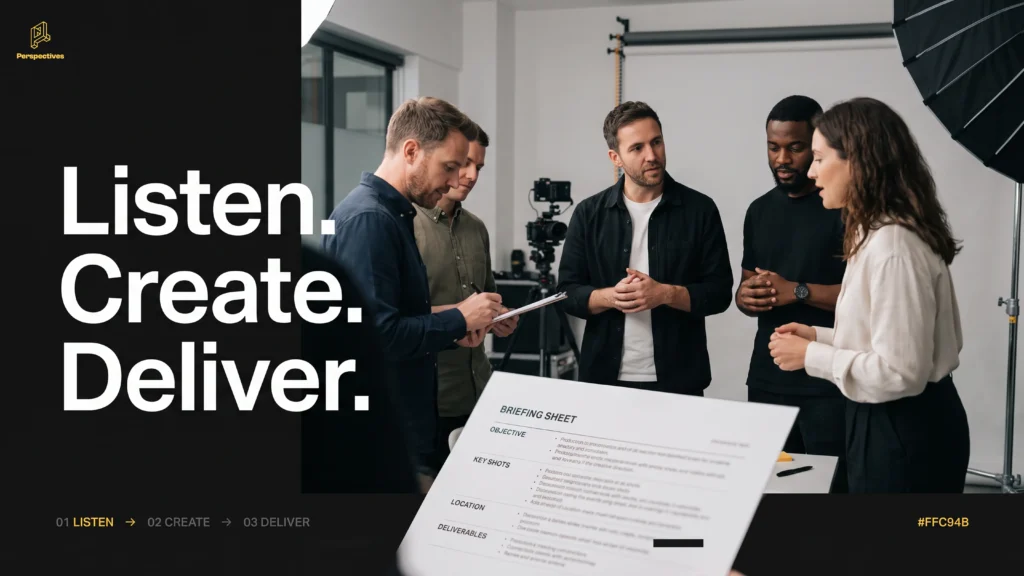
A brief is only as useful as the studio reading it, and this is where a lot of shoots quietly fall apart even with a decent document in hand. Knowing how to brief a photographer is only half the equation, the studio on the other end has to actually work off it.
Perspectives runs every project through Co-Crafted Vision, which means we do not impose a fixed house style onto your brief. We start with a real conversation, the Listen stage of our process, so the document you send us becomes a working plan rather than a wish list nobody checks against. This is the same approach behind our photography services, covering product and lifestyle shoots, team and leadership portraits, and facility photography, all planned from your brief rather than a generic template.
If your shoot needs to say something specific about the brand, not just look good, our brand storytelling and creative production work helps translate a rough brief into messaging and visual direction the photographer can actually shoot to. And if the project needs motion as well as stills, our videography services run off the same document, so a product launch or facility walkthrough looks consistent across every format.
Clients like Fastrack, Exide Energy, and Hitachi Vantara have trusted this process, and it is why we ask for a proper brief before day one, not a mood board on the morning of the shoot. Read more about the studio and its 20+ years of experience on our About Us page.
FAQs
What is the most important thing to include when learning how to brief a photographer?
The shot list. A clear objective helps, but an exact list of deliverables is what stops a photographer from guessing what you actually need on the day.
How detailed should a brand shoot brief be?
Detailed enough that someone who was not on the planning call could still understand the goal, the shot list, and the brand references. It does not need to be long, just specific.
Can I reuse the same photography brief template for every shoot?
Yes, with small edits. The core sections (objective, shot list, references, platforms, timeline) stay the same, only the specifics change per project.
Do I need brand guidelines ready before I brief a photographer?
Not fully finalised ones, but at least reference images or a colour palette. A photographer working with zero visual reference will default to their own style by default, which is a common gap our piece on brand photography for startups covers in more detail.
How far in advance should the brief be sent?
At least three to five days before the shoot, so the photographer and stylist have time to plan lighting, props, and location around it.
What happens if I do not know how to brief a photographer myself?
A good studio will walk you through it. At Perspectives, the Listen stage of our process exists exactly for businesses that know what they want the shoot to achieve but have not written it down yet.
Conclusion
Learning how to brief a photographer is not extra homework before a shoot, it is the single thing most likely to decide whether that shoot delivers usable photos or an expensive folder of images nobody quite needed. A clear brief, built from a simple photography brief template, turns a shoot day from guesswork into execution. Get the brief right, and the photographer can finally do the part they are actually good at.
Key Takeaways
- Most brand shoot disappointments come from a missing brief, not a bad photographer.
- Knowing how to brief a photographer matters more than picking the most talented one available.
- A strong brand shoot brief always includes objective, shot list, brand references, platforms, and timeline.
- A simple photography brief template beats a long creative document nobody reads properly.
- Send the brief three to five days before the shoot, not on the morning of it.
- Vague adjectives like “premium” or “clean” need specific visual references to be useful.
- A missing shot list is the single biggest cause of expensive reshoots.
- Usage rights and platform needs should be part of the brief, not an afterthought.
- The same template can be reused across shoots with small edits.
- A studio that asks for a proper brief before day one is planning for your outcome, not just the shoot.
Your story is worth telling well. Book a Call and let’s turn your brief into photography that actually works.