

If you’re evaluating your company website and wondering whether the visuals are working for or against you, B2B website photography is usually the answer. It’s the difference between a homepage that looks like stock filler and one that makes a buyer believe, within seconds, that your business is exactly as capable as it claims to be and for a B2B site trying to win a six or seven figure deal, those first few seconds matter more than most companies realise.
A Bangalore SaaS company spent months building an enterprise product. Then their website went live with stock photos of people shaking hands in an office nobody on the team had ever set foot in. A procurement head evaluating three vendors clicked through, scrolled for nine seconds, and picked someone else. Not because the product was worse, but because the site looked like it belonged to a company that did not fully exist yet.
That is the quiet cost of skipping B2B website photography, and it happens more often than most founders realise.
Don’t want your homepage to be the reason a deal slips away? Click here to get a quote for B2B website photography with Perspectives.
Table of Contents
- Why B2B Buyers Decide Before They Read a Single Line
- What Stock Images Really Cost a B2B Website
- B2B Website Photography vs Consumer Brand Photography
- What Trustworthy Brand Visuals Actually Look Like on a B2B Site
- Where B2B Website Photography Should Show Up On Your Site
- How Perspectives Approaches B2B Website Photography
- Conclusion
- FAQs
- Key Takeaways
Why B2B Buyers Decide Before They Read a Single Line

Enterprise buyers like to believe they are rational. They compare pricing sheets, read case studies, ask for references. But before any of that, they land on a homepage and form an opinion in seconds, long before reading a single sentence of copy.
That opinion is built almost entirely on what they see. A generic hero banner, a stretched stock photo of a diverse team laughing at a laptop for no reason, a logo grid with no context: all of it registers as a small, silent warning sign. Not “this company is a scam.” Something quieter: “this company might not be as serious as it claims to be.”
This is exactly why B2B website photography matters more than most procurement checklists admit. A buyer comparing three vendors for a six or seven figure contract is really asking, without realising it: does this business look like it can deliver what it promises? Even Google’s own guidance on what counts as a high quality website image treats sharp, original, well-lit photography as a baseline, not a bonus. Good brand visuals answer the trust question before a single word of copy gets read.
What Stock Images Really Cost a B2B Website
Here is the uncomfortable part. Stock photography does not just look generic. It actively works against the trust a B2B website is supposed to build, and recent LinkedIn B2B research found that 94% of marketers now see trust as the single biggest factor in B2B brand success.
Think about it from the buyer’s side. They already know that stock photo of the “team meeting” is not your team. They have seen the same image on four other vendor websites this week. Instead of feeling reassured, they feel slightly misled, even if nobody intended to mislead them.
A few specific costs worth naming:
- It flattens your differentiation. Identical-looking photography makes buyers unable to tell what makes you different, however strong the product is.
- It undercuts your case studies. A results-driven case study loses credibility fast when the “team” photo beside it clearly is not your team.
- It signals under-investment. Buyers read visual quality as a proxy for operational quality. Cheap-looking photos suggest corners get cut elsewhere too.
This is why professional photos for company website use are not a design nicety. They are a trust signal that sits right next to your pricing page and your client roster in a buyer’s mental checklist.
B2B Website Photography vs Consumer Brand Photography
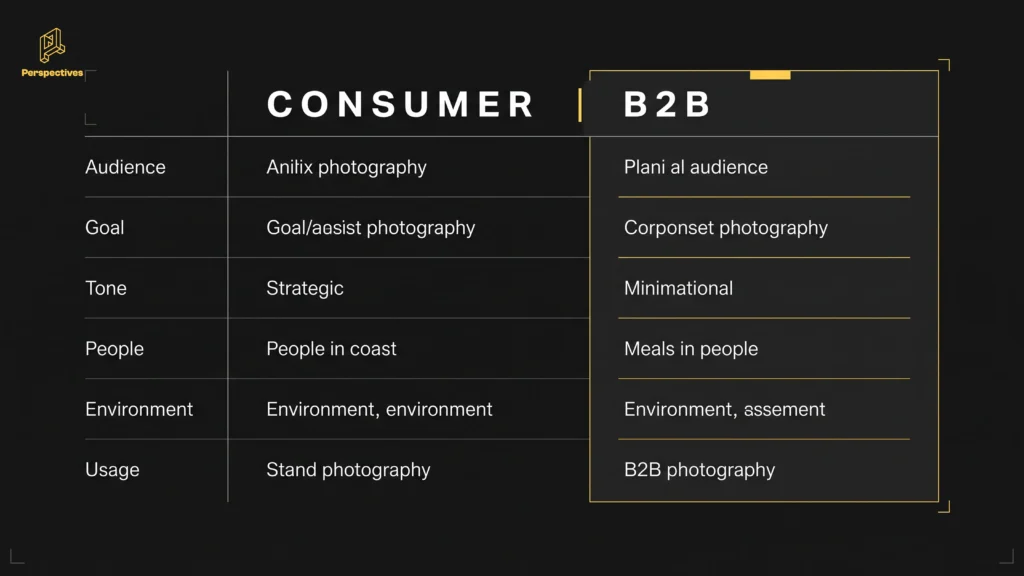
It is worth being precise here, because this kind of photography is not the same brief as a consumer brand shoot, and treating it that way is where a lot of companies go wrong.
Consumer brand photography usually sells a feeling. A B2B buyer is not shopping for one. They are trying to answer a narrower, more practical question: can this vendor actually execute, and will working with them feel professional and low-risk?
That changes what good imagery needs to do here:
| Element | Consumer Brand Photography | B2B Website Photography |
| Primary goal | Evoke a feeling or lifestyle | Build credibility and clarity |
| Subjects | Models, lifestyle scenes | Real leadership, real teams, real facility |
| Tone | Aspirational, emotive | Confident, precise, trustworthy |
| Where it lives | Social feeds, campaigns | Homepage, about page, pitch deck, LinkedIn |
| What buyers ask | “Do I want this?” | “Can I trust this company?” |
Neither approach is wrong, they simply solve different problems. A B2B site that borrows too heavily from consumer-style imagery, all mood and no substance, ends up looking decorative instead of credible.
What Trustworthy Brand Visuals Actually Look Like on a B2B Site
So what actually earns trust, once you move past “just don’t use stock photos”? A few patterns show up consistently wherever this kind of photography works well.
Real leadership, shot with intent. Not a stiff studio headshot against a grey backdrop, and not a casual snap from last year’s team outing either. Leadership portraits need enough polish to signal seriousness, and enough personality to signal that a real person, not a logo, is accountable for what the company delivers.
Facility and process, not just faces. If you manufacture, ship, code, or build anything physical, showing the actual place and process does more for credibility than another headshot. A clean, well-lit shot of your production floor or engineering team mid-work tells a buyer more than a paragraph of copy could.
Consistency across every touchpoint. This is where most B2B companies quietly fail. The website has one visual style, the pitch deck has another, and the LinkedIn page looks like a third company entirely. Brand visuals only build trust when they stay consistent, because a buyer who sees three different “brands” across your touchpoints starts wondering what else is inconsistent behind the scenes.
Where B2B Website Photography Should Show Up On Your Site
A common mistake: treating photography as a one-time homepage decision instead of a system that shows up everywhere a buyer looks.
At minimum, this kind of photography should cover:
- Homepage hero – the first seven seconds of judgment happen here.
- About/leadership page – buyers look for the humans behind the business before booking a call.
- Team and leadership portraits – reused across the site, LinkedIn, and decks so the brand looks like one company.
- Facility or process shots – valuable for manufacturing, logistics, real estate, and infrastructure businesses.
- Case study and client story pages – paired with real imagery instead of generic stock.
- Sales decks and proposals – the same professional photos for company website use should extend to anything a sales team sends a prospect.
If you are unsure where to start, our earlier piece on how to plan a brand photoshoot for your company website walks through the planning process, and our guide comparing brand photography vs corporate photography is worth a read if you are still deciding which type of shoot your business needs.
How Perspectives Approaches B2B Website Photography

Bangalore has no shortage of studios that will shoot a few headshots and call it a day. Perspectives approaches this differently, because a B2B site cannot afford to look like every other vendor’s site.
Every project starts with Co-Crafted Vision instead of an imposed house style. We spend time understanding what your buyers actually need to see, whether that is your engineering floor, your leadership bench, or a facility that proves you can deliver at scale. This is the same craft-first approach behind our photography services, where corporate and event photography, leadership portraits, and facility imagery are handled end-to-end.
If your visuals need to work as hard on LinkedIn and in a pitch deck as on your homepage, our brand storytelling and creative production work keeps the messaging behind every image consistent. For companies that also need their story told in motion, our videography services extend the same credibility-first approach into brand films and facility walkthroughs.
Clients like BearingPoint, Schneider Electric, Hitachi Vantara, and COWRKS have trusted this process, and brands that invested in professional brand assets with us have seen conversions increase by as much as 42%. That is what happens when this type of photography is built to answer a buyer’s real questions, not just fill space on a homepage. Learn more about the studio and its 20+ years of experience on our About Us page.
Want to talk through what your buyers actually need to see? Call us and we’ll help you plan B2B website photography that fits your business.
FAQs
What exactly counts as B2B website photography?
Homepage imagery, leadership and team portraits, facility or process shots, and visuals used in case studies, decks, or LinkedIn content, all built to make a business look credible to another business.
How is B2B website photography different from a regular corporate shoot?
A regular corporate shoot might just cover headshots. This kind of photography is planned around what a buyer needs to see to trust you, so it includes facility, process, and leadership imagery working as one system. Our comparison of brand photography vs corporate photography breaks this down further.
Do we need professional photos for company website use if our product speaks for itself?
Yes, buyers judge credibility before they evaluate the product. Even the strongest product page loses impact if the visuals around it look generic or outdated.
How often should B2B website photography be updated?
Refresh core imagery every 12 to 18 months, sooner if the team, office, or product changes significantly. Outdated visuals are almost as damaging as generic ones.
Can B2B website photography be reused across LinkedIn, decks, and the website?
Yes. Planning one shoot for multiple uses is more efficient than separate shoots per channel, and it is how we approach every photography project.
Conclusion
B2B buyers judge your business before they read a single word of copy, and that judgement is built almost entirely on what they see first. Stock photography quietly undercuts the trust you are trying to build, while consistent B2B website photography does the opposite: it tells a buyer, in seconds, that your business is as capable as it claims to be. Investing in professional photos for company website use is not decoration, it is what gets the rest of the page read at all.
Key Takeaways
- B2B buyers form a credibility judgement within seconds of landing on a website, before reading any copy.
- Generic stock photography quietly signals under-investment, even when the product itself is strong.
- This kind of photography should build credibility and clarity, not just evoke a feeling.
- Consistent brand visuals across the website, deck, and LinkedIn matter more than any single great photo.
- Real leadership portraits build more trust than stiff studio headshots or casual candid shots.
- Facility and process photography proves capability in a way copy alone cannot.
- Professional photos for company website use should extend into decks and proposals, not stay confined to the homepage.
- Case studies land harder when paired with real imagery instead of generic stock.
- These visuals work best as a system refreshed every 12 to 18 months, not a one-time task.
- Purposeful, well-planned B2B website photography gives every other page on your site a fair chance to be read.
Your story is worth telling well. Book a Call and let’s plan the B2B website photography your business actually needs.