
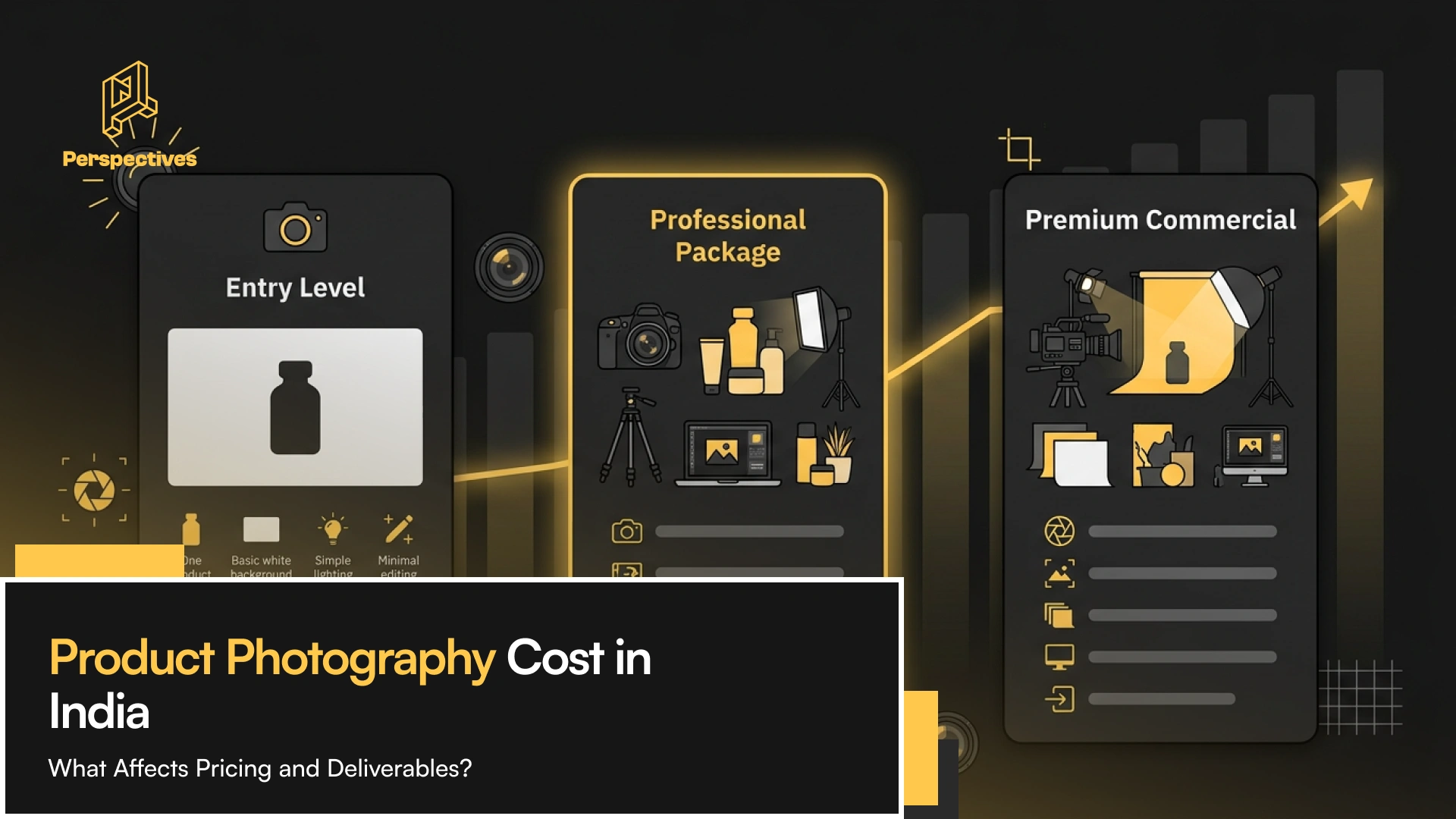
You get three quotes for product photography in India. The first one says 5,000 rupees. The second says 25,000 rupees. The third says 75,000 rupees.
Same city. Same product type. Same timeline. Wildly different prices.
So you pick the cheapest one because you logically think it’s the best deal. You’re not paying for unnecessary extras. You’re being smart about your budget. Then the shoot happens, and you get ten okay photos. Not bad. Just not special. You post them on your e-commerce site and nothing. The conversion rate is still terrible. You’re back to being invisible.
Or you get curious about the expensive one. You look at their portfolio and think, “Okay, those photos are incredible, but I’m not an Instagram influencer; I’m just selling a product.” So you skip it. Then you see your competitor (the one you thought you were better than) using professional photos. And suddenly they’re selling twice as much as you.
The real question isn’t “What’s the cheapest product photography in India?” It’s “Why do prices vary so much, and what do I actually get for my money?”
That’s what this guide is about.
Why Product Photography Pricing in India Is So All Over the Place
Here’s the first thing you need to understand: there’s no standard rate for product photography in India.
This is different from, say, hiring a plumber. Plumbers have pretty consistent rates because they’re solving the same problem for everyone. A leaky tap is a leaky tap. Product photography? It’s not like that.
One photographer charges by the hour. Another charges by the final image. Another charges a flat rate per session. One includes editing. One doesn’t. One has a studio. One shoots on location. One works with models. One doesn’t.
It’s like asking “How much does a meal cost in India?” You could eat for 50 rupees or 5,000 rupees depending on where you go. Both are meals. Both will satisfy you. But the experience is completely different.
This is why you see such wild price swings. They’re not all the same product. They just have the same label.
The key is understanding what you’re actually paying for at each price point. Because “cheap” doesn’t mean “bad,” and “expensive” doesn’t mean “better.” It means different. And different affects your sales.
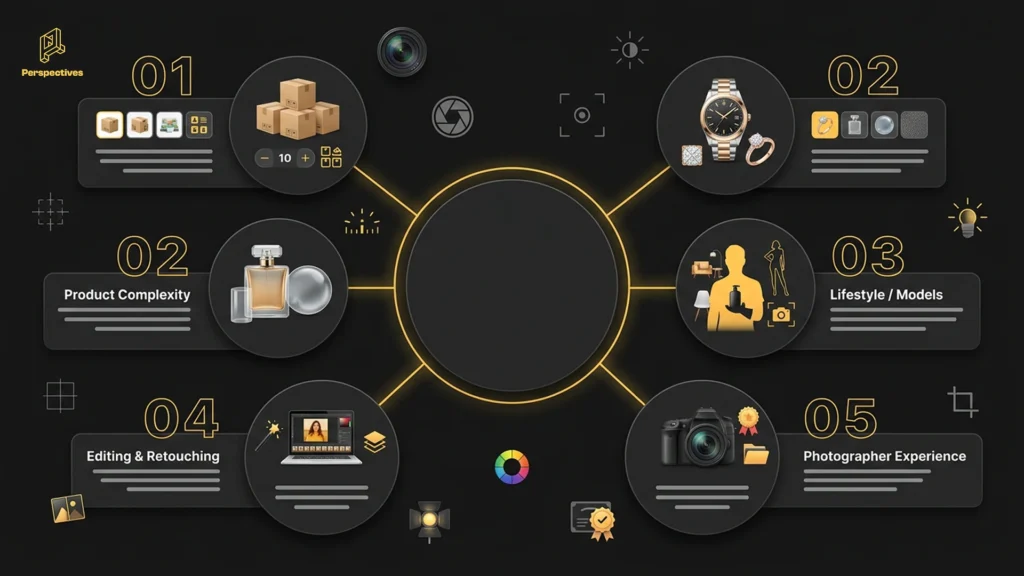
The Five Things That Actually Affect Your Product Photography Cost
If you’re trying to understand why one quote is 5,000 rupees and another is 50,000 rupees, here are the real factors:
1. Volume of Products
Are you shooting one product? Or 100 products? Shooting more products in a single session costs more upfront but brings down the per-product cost. A photographer charging 2,000 rupees per product for a single shoot might charge 500 rupees per product if you’re shooting 100 products.
2. Complexity of the Product
A simple product is easy to photograph. A T-shirt on a table. Done. A complex product (such as jewelry, electronics, or furniture) takes longer. More angles. More lighting setups. More time. More cost. This is non-negotiable.
3. Whether You’re Using Models and Lifestyle
Adding human elements to your photos adds cost. Models cost money. Styling costs money. Location scouting costs money. If you’re shooting just product on a white background, it’s cheaper. If you’re shooting lifestyle with someone wearing your product, it’s more expensive. Both are valid. Different prices.
4. Level of Finishing and Editing
Basic editing means color correction and simple background removal. Advanced editing includes retouching, shadow work, advanced color grading, and composite image creation. Basic is cheaper. Advanced is more expensive. The finished quality is different.
5. Experience and Portfolio of the Photographer
A newer photographer with a modest portfolio charges less. An established photographer with a proven portfolio of successful product photos tends to charge more. You’re paying for their expertise and their track record. This is why reputation matters, and it’s reflected in pricing.
Understand these five factors, and you’ll understand why quotes vary so much. It’s not random. It’s because you’re asking for different things.
The 5K Shoot: What You’re Getting (And What You’re Missing)
At 5,000 rupees per product (or per session), you’re getting:
Someone with basic photography skills. Possibly a newer photographer building a portfolio. They have a camera. They know how to use it. They might have a reflector and a basic lighting setup, or they might be relying on natural light.
One or two angles per product. Maybe three if you’re lucky. Not much variety. The shot is taken, edited lightly (color correction, maybe background removal), and delivered. Done.
Fast turnaround. The shoot day is quick. The editing is quick. You’re not getting analyzed, strategic thinking about what makes your product sell. You’re getting efficient image production.
Basic editing only. If your background needs complex removal, your product needs retouching, or you want advanced color grading, this price point won’t deliver that. You get the basics.
No strategy. The photographer isn’t thinking about “Which angle makes this product look premium?” or “What will convert on Amazon?” They’re thinking “Let me get a photo that looks decent.”
What you’re missing: Professional consistency. The six photos in your catalog from a 5K shoot might look wildly different in terms of tone, lighting, and color grading. It feels fragmented, not like a curated collection.
When is 5K enough? If you’re shooting a small volume of very simple products and you don’t mind basic quality, 5K works. If conversion rates don’t matter much to you. If you just need to have photos online. If you’re okay looking like a startup in someone’s feed while your competitors look professional.
Most brands aren’t fine with that. Which is why most brands don’t stay at 5K.
The 25K Shoot: Where the Jump Happens
At 25,000 rupees, the jump from 5K is huge. Here’s what changes:
You’re getting a professional photographer with real experience. A portfolio that shows they’ve successfully done this before. They have a studio or a professional shooting space. They have multiple lighting rigs. They know what they’re doing.
Multiple angles and variations. You’re getting 4 to 8 different shots per product. Clean product shots. Detail shots. Different angles. Overhead. Side. Slight angle. This gives you options.
Professional editing. This is where the photo actually becomes premium. Color grading that makes your product look how it actually looks (or better). Retouching. Shadow work. Attention to detail. The difference between a shot taken and a shot designed.
Consistency. All the photos in your catalog look like they belong together. Same lighting style. Same color grading. Same background approach. You look like a real brand, not a collection of random photos.
Some strategy. The photographer is thinking about angles that work for e-commerce. They know what works on Amazon. They’re probably asking you questions about where these photos will be used.
What you’re still missing: Lifestyle content. Modeling. Location shoots. High-end finishing. This is still primarily product photography on a controlled background.
When is 25K the sweet spot? For most established e-commerce brands. You get professional quality without paying premium prices. Your photos look good. Conversions improve noticeably. You’re no longer losing to your competitors based on photo quality.
Most smart brands start here. Not the cheapest. Not the most expensive. The smart middle ground.
The 50K+ Shoot: Why Premium Costs What It Costs
At 50,000 rupees and above, you’re entering full-spectrum production. Here’s what that means:
You’re getting a photographer with an established portfolio and proven track record. This isn’t their first brand. They’ve photographed successful e-commerce companies. They know what sells. You’re paying for that expertise.
The complete package. Product shots on white. Detail shots. Lifestyle content. Maybe models. Maybe multiple locations. You’re getting a full visual system, not just product photos.
- Professional retouching and color grading at the highest level: Every image is designed with careful shadow and light work, and optimized composition. This is where a photo stops being a photo and becomes an asset that’s built to sell.
- Strategic thinking: A high-end photographer isn’t just shooting. They’re asking about your target customer, your competition, and your platform. They’re thinking about what will actually move your conversions and using their experience to make decisions that you might not even realize matter.
Complete consistency. All photos look like they were shot in the same professional session, with the same brand vision, on the same day. You look premium.
Often includes retouching of imperfect products. If your product has a minor blemish, a professional shoot at this level can handle it. You’re getting the best version of your product.
What you’re paying for: Peace of mind. Expertise. Track record. The guarantee that your photos will actually move conversions because they’re built by someone who knows how to move conversions.
When is 50K+ worth it? When you’re launching a new brand, and you need to look premium from day one. When your current photos are clearly holding back your sales. When you’re selling high-end products where the photography is part of the brand story. When you have a decent volume of shoots and want the photos to work hard for you across all platforms.
The Hidden Cost of Cheap Product Photography
Here’s what nobody tells you: cheap photography has a cost that doesn’t show up in the invoice.
Let’s say you spend 5,000 rupees on product photography. The photos are decent. Not great. But online, you think, “Whatever, this is fine, I’m saving money.”
Then you launch. Your competitor, with 25,000-rupee photos, launches around the same time. Same product quality. Similar pricing. But their photos look way better.
You’re not selling. They’re selling. You’ve recouped your 5,000-rupee investment zero times because no one bought. They’ve recouped their 25,000-rupee investment several times over because people are actually clicking and buying.
The real cost of cheap product photography is the lost revenue. The traffic that came and didn’t convert. The customers who went to your competitor instead.
It compounds. The longer you stay with cheap photos, the more conversions you lose. Months go by. You’re still at the same sales level. Your competitor is growing. And now the gap is so big it’s hard to catch up.
There’s also the cost of replacement. Eventually you realize the photos aren’t working. So you hire someone better. Now you’re spending 25,000 or 50,000 rupees when you could have spent it once at the beginning and never looked back.
Plus there’s the loss of credibility. Your photos look amateur. In your customer’s mind, your brand looks amateurish. This affects everything. Reviews. Return rates. Customer trust. It’s not just about the photo. It’s about what the photo communicates about your brand.
Truly cheap product photography isn’t the 5,000-rupee shoot. It’s the one that costs you ten times that in lost sales.
Why Perspectives Charges What It Charges
We’re not the cheapest option in Bangalore. We’re also not the most expensive. But we’re intentional about what we charge and why.
Our product photography pricing reflects what you actually get. You get a photographer with 20+ years behind the lens. You get a studio. You get professional lighting. You get strategic thinking about what makes your product sell on different platforms. You get a complete product visual system that works across Amazon, Instagram, and your website.
Here’s the honest truth: we charge based on what we deliver and the actual ROI for you. A product photography shoot costing 35,000 rupees sounds expensive until you realize your conversion rate has jumped from 1 percent to 2.5 percent. Now that shoot paid for itself in the first month.
We’ve worked with jewelry brands, fashion labels, F&B companies, and beauty brands. All of them came to us comparing quotes. All of them initially thought they’d go with someone cheaper. All of them realized that the difference in quality was worth way more than the difference in price.
We also understand that you have a real budget. We work with what you can spend. We’re not here to oversell. We’re here to be honest about what’s possible at different price points and help you make the decision that’s actually right for your business.
You can book a call, and we’ll walk through exactly what you need, what it costs, and the expected ROI. No surprises. No upselling. Just honest conversation about what you’re actually paying for.
FAQs
Why is product photography so expensive in India?
It’s not actually expensive compared to other countries. And it’s not expensive compared to what it returns if you choose wisely. A 25,000-rupee shoot that increases your conversions from 1 percent to 2.5 percent will pay for itself in weeks. Compare that to your total marketing spend.
Can I negotiate product photography prices?
Sometimes. But be careful. Negotiating a professional photographer’s price down is often negotiating their quality down. What changes is what you get. If you want to negotiate, understand what you’re giving up. Are fewer products okay? Simpler editing? Faster turnaround?
Is product photography worth it for small e-commerce brands?
Yes. Small brands especially benefit from professional photos because they’re usually competing with bigger brands that have professional budgets. Good photos are among the few ways to compete on equal footing.
What’s the difference between a 25K shoot and a 50K shoot?
Usually volume, complexity, and finishing. A 25K shoot typically includes 10 to 20 professional-quality products. A 50K shoot might be 30 to 50 products, or fewer products but with advanced editing and lifestyle content.
Should I get product photography done once or updated regularly?
If your products don’t change, once is enough. But if you’re launching new products, new colors, seasonal items, or refreshing your brand, new photography makes sense. Also, if your current photos aren’t converting well.
How do I know if a photographer is worth their price?
Look at their portfolio. Do the products look premium and desirable? Can they explain the strategy behind the photos? Have they worked with brands similar to yours? Are they asking smart questions about your business and goals?
Conclusion
Product photography cost in India isn’t a simple number. It’s a reflection of what you’re getting and what value that delivers to your business.
The cheapest option isn’t always the worst deal. But the most expensive option isn’t always the best either. The right choice is the one that matches what you’re trying to do and what your budget can handle.
If you’re just starting out and need something to get online, 5K might be fine. If you’re serious about converting and growing, 25K is usually the sweet spot. If you’re building a premium brand and you need photos that do heavy lifting, 50K+ makes sense.
But here’s the thing: the decision should be based on ROI, not just on the invoice. What will these photos actually make you in return? That’s the real cost. That’s what matters.
Key Takeaways
- Product photography pricing in India varies wildly because photographers offer very different services.
- Five main factors affect cost: volume, product complexity, lifestyle/models, editing level, and photographer experience.
- At 5K, you get basic product images. At 25K, you get professional consistency. At 50K+, you get a complete visual system.
- The real cost of cheap photography is the lost conversions, not the upfront invoice.
- Professional product photography usually pays for itself within weeks through increased conversion rates.
- Different price points serve different needs. Choose based on ROI, not just budget.
- Established photographers charge more because they know what sells and they have a track record.
- Cheap photography compounds over time. The longer you keep cheap photos, the more you lose.
- Premium pricing reflects professional quality, strategic thinking, and guaranteed results.
- The right product photography isn’t the cheapest or the most expensive. It’s the one that’s actually worth it for your business.
Stop choosing product photography based on the lowest quote.
Book a call with Perspectives and let’s talk about what your business actually needs. We’ll break down the pricing, explain what you get at different levels, and help you understand the ROI. Whether you need a simple product shoot or a complete visual system, we’ll be honest about what makes sense for you.
Your product photography isn’t an expense. It’s an investment. Let’s make sure it’s an investment that pays.