
You schedule your corporate video shoot. Everything feels locked in. You picked the producer. Booked the location. Cleared the calendar. Then, two days before the shoot, someone sends an email: “BTW, what’s the message supposed to be?” And suddenly you’re scrambling. Because nobody actually talked about what this video is supposed to move people to do. The script doesn’t exist. Your executives have no idea they’re being filmed. The location looks nothing like what the producer imagined. And now you’re about to spend 40 thousand rupees on a production that might miss the entire point.
This happens more than you’d think. Not because people are careless. But because when you’re planning corporate video production, there’s a difference between “planning a shoot” and “planning a video.” One is logistics. The other is strategy. Most businesses do the first and skip the second.
Here’s what you actually need to think through before you even touch a camera.
Before You Pick a Producer, Know Your Single Core Message
Most businesses book a corporate video production team and then try to figure out what the video should do during the first call. This is backward.
Here’s the reality: if you don’t know what you’re trying to move people to do, your producer can’t either. You can’t build the right visuals, the right script, the right tone if nobody’s clear on the core message.
And I don’t mean “our core message is to build brand awareness.” That’s not a message. That’s a category. A message is specific. It’s actionable. It’s the one sentence that, if your viewer remembers nothing else, matters.
Think about it this way. You’re a software company. Are you trying to convince people you exist? That you’re cheaper? That you solve a problem they didn’t know they had? That you’re trustworthy enough to replace the tool they’re already using? These are completely different videos. They need different visuals, different spokespeople, different settings.
Before you talk to a producer, sit with your team for one hour. Not three hours. One. And answer this: “If this video moved exactly one person to take exactly one action, what would that action be?” A call? An application? A partnership inquiry? A download? Write it down.
Once you know that, everything else makes sense. The producer knows what story to tell. The location choices make sense. Your executives know how to show up. Your timeline becomes realistic.
Skip this step, and you’ll spend six weeks in post-production arguing about tone, edits, and whether the color grade feels “premium enough.” Do this step and the entire corporate video production process moves like it knows where it’s going.
The Biggest Planning Mistake: Forgetting to Script Before You Shoot
You’re about to book a shoot, and someone says, “We’ll figure out what they say on camera.” This is how videos become forgettable.
Here’s why: Unscripted corporate video production looks unscripted. Your executives ramble. They repeat themselves. They say “um” and “like” and look uncomfortable. You end up with 12 hours of footage, and only 45 seconds of it is usable. Your editor’s job turns into performing magic with an impossible deck.
A script doesn’t mean your video looks stiff. It means your message is clear before anyone shows up on set.
You need three kinds of planning before your shoot:
The messaging script. This is what the video actually says. What’s the problem you’re solving? What’s the solution? Why should someone care? What’s the call to action? Write this in plain English. Not marketing-speak. Plain English. The kind of thing you’d actually say in a conversation.
The shot list. What visuals do you need to tell this story? Office footage? Product shots? B-roll of the team working? Leadership interviews? Write it down. Not in a 40-page storyboard. In a simple list. “We need shots of the product in use. We need the CEO talking to camera. We need 30 seconds of the team collaborating.”
The location checklist. What should the location look like? Bright? Moody? Corporate? Casual? If you’re shooting in your office, what needs to be moved or hidden? What’s the lighting like when you’re shooting? Is there noise you’ll have to work around?
The producer should help you build this. But you need to drive it. You know your business. You know your message. You know what feels authentic for your brand.
If your producer says, “Don’t worry, we’ll figure it out on the day,” that’s a red flag. Good corporate video production teams want this locked before they arrive.
Your Location Isn’t Just a Backdrop (But Most People Treat It That Way)
You’re shooting in your office. What could go wrong?
More than you think. And most of it shows up on camera in ways you don’t notice until you’re watching the rough cut.
Your office was designed for people to work in. Not for cameras. The lighting is fluorescent and flat. There’s a window that creates a glare problem. Your meeting room looks corporate-sterile, which is fine for meetings but comes off as dead on video. There’s a printer humming in the background that you don’t hear when you’re in the room but becomes the only thing you hear in a recording.
Here’s what you need to do before your shoot:
Walk your location as a camera operator would. Not like you’re at work. Move around your space and notice what catches the light, where the shadows are, and where the view feels open or closed. Are there distracting backgrounds? A poster that looks dated? Clutter on desks? These things you walk past every day become the visual story when a camera is pointed at them.
Test the audio. Stand in the location where you’ll be filming and record 30 seconds on your phone. Listen back. What noise becomes obvious? Traffic outside? HVAC humming? Printers? Co-workers talking nearby? Now ask yourself: can your producer work around this, or do we need a different location?
Plan the lighting. Natural light is beautiful but unpredictable. If you’re shooting in the morning, where will the sun be by afternoon? Does your office have backup lighting if the day is grey? If you’re shooting in a conference room with no windows, what will the lighting look like?
The best corporate video production teams bring their own lighting rigs. But they need to know what they’re working with before they show up. Give them that information.
This isn’t overthinking it. This is not shooting a video that feels apologetic about being shot in your office.
Why Your Executives Need To Practice, Not Just Show Up
Someone in leadership agreed to be on camera. They’re “natural on camera.” They’ll be fine.
Maybe they will. Or maybe they’ll freeze. Or talk too fast. Or look at the camera like it’s alien. Or go into CEO mode and start sounding like a corporate robot.
You need your spokespeople to practice. Not for hours. But enough to feel comfortable saying your message in front of a camera.
Here’s what that looks like:
One rehearsal before the shoot. Your executive reads the script. Out loud. While someone records them on a phone. They watch it back. They feel the awkwardness. They do it again. By the third take, they’re more relaxed. By the fourth, they’re not overthinking it.
Knowing why they’re saying what they’re saying. If your CEO understands the story you’re telling, they can deliver the message with confidence. If they’re just reading words, it shows.
Understanding the visual context. Will they be sitting or standing? Are they looking at the camera or just having a conversation? Will there be other people in the shot? If they know what they’re walking into, they’re less likely to be surprised.
Good producers direct spokespeople during the shoot. But they can’t fix someone who’s terrified of being on camera. That only changes with practice before the cameras roll.
The Crew Size Question Nobody Asks Until It’s Too Late
How many people do you need on a shoot? One person can hold a camera. Two people can probably handle it. Three people is more professional. But what does your project actually need?
This matters because it affects your budget, your timeline, and the quality of what you end up with.
A one-person shoot usually consists of just a camera operator. Fast, lean, but limited. You can’t do complex lighting. You can’t do complex audio. You can only shoot one angle at a time.
A two-person crew typically consists of a camera operator and a sound person. This is usually enough for interviews and basic production. You get better audio. You can move faster because someone isn’t juggling multiple jobs.
A three-person crew is an operator, a sound person, and a gaffer (lighting). Now you can actually light your shots. You can do multiple angles. You can handle complexity.
The question you need to ask before your shoot is: “What am I trying to make?” An interview-heavy corporate film needs good audio and probably basic lighting. A product launch needs multiple angles and controlled lighting. A facility walkthrough needs smooth camera movement and no audio surprises.
Your producer should recommend crew size based on your shot list. But when you’re evaluating corporate video production options, you need to know what each role does and why it matters.
Don’t cheap-skate on crew size. A video with bad audio or flat lighting doesn’t look “budget-conscious.” It looks amateur. And you’ve already paid for the whole shoot.
Post-Production Planning Starts Before Your Shoot Ends
Here’s a thing nobody tells you: Your edit decisions start on the day of the shoot. Not in post-production.
If your producer hasn’t shot enough coverage, your editor has nothing to work with. If your sound is messy, no amount of editing can fix it. If your B-roll doesn’t match the script, the story doesn’t land.
Before your shoot, you need to agree on a few things:
How much footage will you shoot? One take per message? Three takes? Five?: More is always better. Your editor needs options. But you also can’t shoot for three days when you planned for one.
What’s the backup plan if something doesn’t work? Your CEO goes blank during the interview. The weather changes. Someone gets sick. What do you do? Do you have an alternative location? A backup spokesperson? A script adjustment ready to go?
How involved will you be in post-production? Will you review cuts? Who decides on music? Who approves color grading? The earlier you clarify this, the fewer surprises you get when you see the rough cut.
What’s the deadline and approval process? When does the producer deliver? How many revision rounds are included? What happens if you want major changes after the first cut?
This sounds like a lot of logistics. But it’s the difference between a corporate video production team that’s scrambling because expectations aren’t clear and one that delivers exactly what you need because everyone agreed on it before the shoot started.
Why Bangalore Brands Trust Perspectives for Full-Spectrum Production
Most producers give you options: “We can do the shoot, or we can do post-production, or we can both.” That’s vendor thinking. Pieces you have to assemble.
Perspectives handles everything in-house. You don’t book a shoot with one person and then hand off to an editor who has no idea what you were trying to do. One team. Start to finish. That matters.
Here’s what that actually means for you. When we’re planning your shoot, we’re already thinking about how it cuts. When we’re shooting, we’re getting the coverage your editor needs. When we’re editing, we’re protecting the story we all agreed on. There’s no “your vision got lost in the handoff” moment.
Our corporate video production process starts with understanding your business. Not just “what do you want to say” but “who needs to hear this” and “what are they skeptical about.” Once we understand that, we help you script it. We plan the shoot around that script. Then we execute the whole thing in-house.
We’ve worked with brands across Bangalore. Schneider Electric. Hitachi Vantara. BearingPoint. Companies that needed corporate video that felt real, not templated. Our videography services cover the full spectrum: brand films, product launch videos, corporate documentaries, leadership content, facility walkthroughs. Whatever you’re trying to move people to do, we’ve probably done it.
You need a producer who thinks like a strategist, not just a technician. Someone who understands that planning a video is as important as shooting it. That’s what we bring to every corporate video production project. Not just a camera. A whole system that protects your message from concept to final edit.
FAQs
How far in advance should we plan a corporate video?
Ideally, four to six weeks before your shoot. You need time to script, get approvals, prepare your spokespeople, and lock down locations and crew. If you’re planning less than two weeks out, you’re rushing, and something will break.
Do we really need a script for a corporate video?
Yes. Even if parts feel conversational, they should be intentional. An unscripted corporate video usually looks like it. Your executives ramble. Editing becomes impossible. You end up with a video that’s longer than it should be and says less than it needs to.
What if we don’t have a dedicated location and need to shoot in multiple places?
That’s fine, but it adds complexity. You need more travel time. More setup time at each location. More crew coordination. Tell your producer upfront so they can plan the shoot day around movement and timing.
How long should a corporate video be?
That depends on where it lives. A LinkedIn video should be under three minutes. An internal communication can be five to ten minutes. A website hero video should be under two minutes. Know where your video is going before you shoot it.
Can we do reshoots if we don’t like the first cut?
Maybe, but reshoots are expensive and time-consuming. This is why planning and rehearsal upfront matter so much. You’re less likely to need reshoots if everyone knows what you’re making before you start.
How involved should executives be in approvals?
Executive input matters. But too many cooks make decisions slow and edits endless. Decide upfront who approves what. CEO approves the message. Marketing approves the calls to action. That’s usually enough.
Conclusion
Planning corporate video production in Bangalore isn’t about booking a shoot and hoping it works out. It’s about answering hard questions before anyone shows up with equipment.
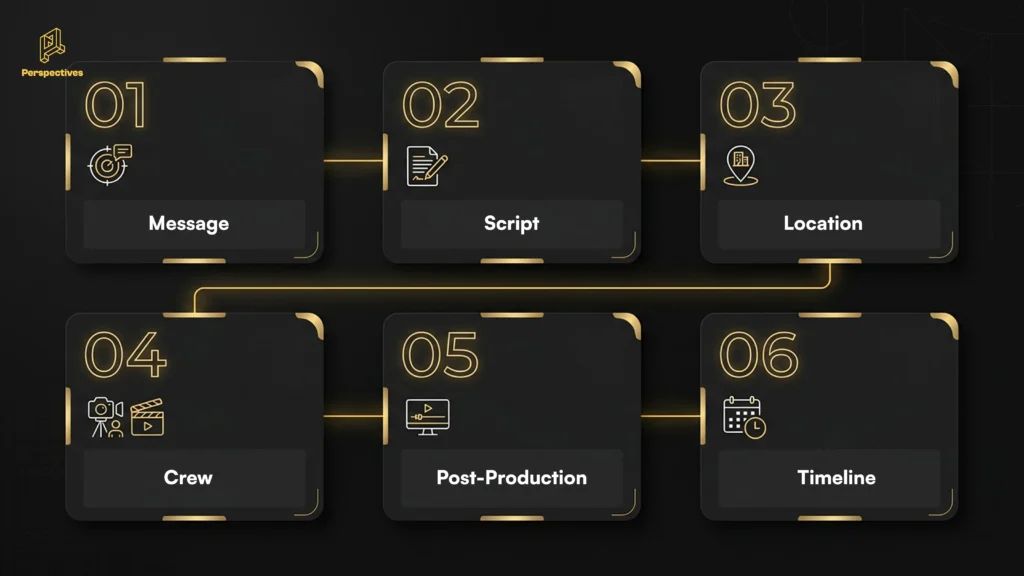
Know your core message. Script before you shoot. Scout your location. Prepare your spokespeople. Plan your crew. Clarify your post-production process. Do these things, and you’ll walk into your shoot day confident, not scrambling.
The difference between a corporate video that moves people and one that just exists is usually invisible to viewers. It’s all the planning nobody sees. The thought that went into every decision. The rehearsal. The location scouting. The script that didn’t happen by accident.
That’s what you’re paying for when you hire a producer who takes planning seriously. Not just the shoot day. Everything that makes the shoot day actually work.
Key Takeaways
- Plan the message before you plan the shoot. Know what you’re trying to move people to do.
- Script before you shoot. Unscripted corporate video usually looks unscripted.
- Scout your location like a camera operator would. Notice lighting, audio issues, and visual distractions.
- Your spokespeople need to practice. Rehearsal on camera before the shoot matters.
- Crew size should match the complexity of your shot list. Don’t cheap-skate on crew and expect quality.
- Post-production planning starts on shoot day. Make sure your producer is getting the coverage you’ll need to edit.
- Clarify approval processes and revision rounds upfront. No surprises in post.
- An in-house production team (shoot to edit) protects your message better than piecing together vendors.
- Location, lighting, and audio are as important as what people say. Don’t treat them like afterthoughts.
- The difference between a good corporate video and a great one is usually all the planning nobody sees.
Your story is worth telling well.
Book a call with Perspectives and let’s plan your corporate video the right way. Every project starts with a conversation. Tell us what you need to move. We’ll show you how to make it happen.